We all want more time, but we also all want to do more things. The problem is, time (and our energy) is limited. You can't control that however you want. From trying to do it all, your mental load builds up, and that can take a toll on your health and wellbeing. You need to find ways to free yourself from it.
What Is Mental Load?
Mental load is the weight that sits on your shoulders when you have a mountain of things to do and you don't know which way to turn anymore. Sounds familiar? 😂 Probably! It's not just something moms deal with, or just women, even though women tend to carry a heavier mental load more often.
It's not just a popular expression: it's a phenomenon that's been precisely defined by research. Sociologist Allison Daminger, now a professor at the University of Wisconsin-Madison, led a landmark study published in the American Sociological Review, based on 70 in-depth interviews conducted with 35 couples. In it, she defines mental load (or "cognitive labor") as a four-step process: anticipating upcoming needs, identifying possible options to address them, making a decision, and then monitoring that everything unfolds as planned. It's that last part that stands out the most: unlike a physical task you can check off a list, this kind of work has no clear start or end. It can happen anytime, anywhere, running quietly underneath everything else. That's exactly what makes it so exhausting, and so hard for the people around you to see.
I'm suggesting these 5 tricks to help reduce yours.
1. Write Everything Down
Write down absolutely everything. You can't remember it all. Use the tools available to you, set alarms. There's no point putting pressure on yourself to remember every single thing you need to do.
If you want to reduce your mental load, you need to use a calendar and make lists. Google Calendar could become your best friend (in the virtual friends category, let's say. I don't think it replaces sushi dinners with your real friends).
This is exactly where Daminger's definition becomes useful: the heaviest part of mental load is "monitoring," meaning constantly keeping track in your head of whether something has been done or not. Writing things down means transferring that monitoring from your brain to a reliable external system. A Notion template to centralize your lists and tracking, or a spreadsheet for your recurring tasks, does exactly that work for you: it becomes the external memory that lets you truly switch off.
2. Stop Chasing Perfection
A great way to blow up your mental load is to constantly chase perfection. It's like a pedestrian running after their bus while the driver never sees them. You're gonna lose, no matter how fast you are.
Perfection doesn't exist, period. Try aiming for "good enough" instead. And above all, stop comparing yourself to others. It's you VS you.
This isn't just wellness advice: the pressure of perfectionism is a measurably growing phenomenon. A meta-analysis published in Psychological Bulletin, conducted by researchers Thomas Curran and Andrew Hill, compared perfectionism levels reported by college students between 1989 and 2016. Their finding: perfectionism increased significantly over time, particularly the pressure to appear perfect in the eyes of others. And it's not just uncomfortable: other research has established a direct link between perfectionism and symptoms of anxiety and depression. Aiming for "good enough" instead of "perfect" isn't a compromise then, it's real protection for your mental health.
3. Anticipate and Prepare
When you anticipate problems and prepare for them ahead of time, you avoid being reactive and at the mercy of your obligations. Take charge of things instead of letting them catch you off guard at the last minute. Preparation is key.
In her study, Daminger specifically identifies anticipation as one of the most invisible and hardest-to-"turn-off" forms of mental load: unlike a physical task, constantly scanning the horizon for what's coming doesn't fit into a schedule and never really stops. The good news: by setting aside dedicated, regular time for that anticipation (a weekly review, for example), you can actually contain that mental activity within a specific window, rather than letting it run continuously in the background of your mind.
4. Delegate and Learn to Trust
You've probably already been told to delegate, whether in your personal or professional life. You can delegate your housework, your meals, quite a few tasks. But it's pretty pointless if you don't trust the person you're delegating to enough. The goal isn't to redo everything behind them and spend twice as much time doing it. Delegate for real.
This is an important point, and research confirms it: delegating only the execution of a task, while keeping the decision-making and monitoring for yourself, barely reduces your actual mental load. For delegation to truly work, you also need to hand over part of the decision-making power, not just the physical action.
5. Eliminate!
In your environment as much as in your schedule, the best way to reduce your mental load is to learn to eliminate (and to say no more often). Get rid of everything you don't use, because yes, having more stuff means a heavier mental load.
Take the time to identify what you truly want to do in every area of your life, and eliminate what doesn't serve you in your schedule. Set your priorities based on what has the biggest impact toward your goals.
Frequently Asked Questions
Does mental load really affect women more?
Yes, according to sociology research, women carry, on average, a larger share of cognitive labor within a couple, particularly its most invisible forms, like anticipation and monitoring. That said, it's not exclusive to women or mothers.
Why does writing down my tasks really reduce my mental load?
Because it transfers the most exhausting part of cognitive labor, constantly monitoring what's left to do, from your brain to a reliable external system.
Is chasing perfection really harmful?
Yes. Research shows that perfectionism is on the rise and is directly associated with symptoms of anxiety and depression.
Why isn't delegating a task always enough to reduce my mental load?
Because if you keep the decision-making and monitoring for yourself, you're holding onto the heaviest part of the work, even if someone else physically carries out the task.
Talk soon!
-
Sale!

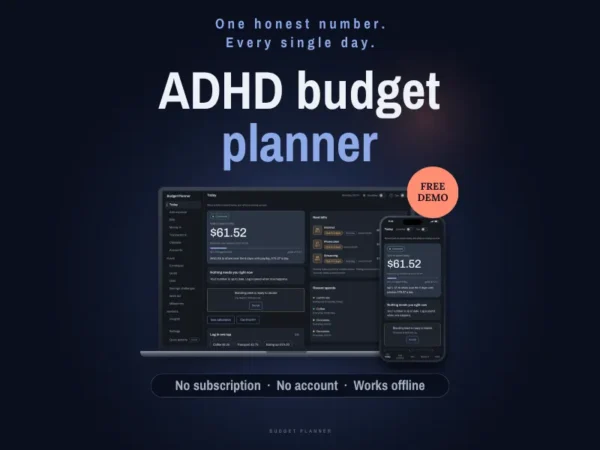
ADHD Budget Planner – App
Original price was: 30.00$.15.00$Current price is: 15.00$. -
Sale!
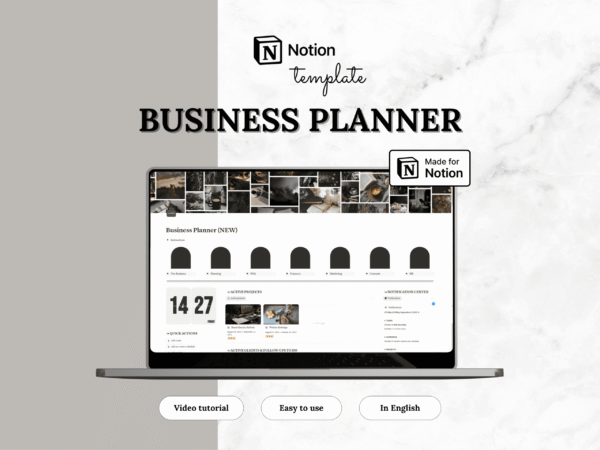
Notion template — Business planner
Original price was: 63.00$.31.50$Current price is: 31.50$. -
Sale!
Notion template — Career planner
Original price was: 16.00$.8.00$Current price is: 8.00$. -
Sale!
Notion template — Event planner
Original price was: 19.00$.9.50$Current price is: 9.50$. -
Sale!
Notion template — Fitness planner
Original price was: 19.00$.9.50$Current price is: 9.50$. -
Sale!
Notion template — GTD planner
Original price was: 20.00$.10.00$Current price is: 10.00$. -
Sale!
Notion template — Home management
Original price was: 19.00$.9.50$Current price is: 9.50$. -
Sale!
Notion template — Language learning
Original price was: 12.00$.6.00$Current price is: 6.00$. -
Sale!
Notion template — Life planner
Original price was: 47.00$.23.50$Current price is: 23.50$. -
Sale!
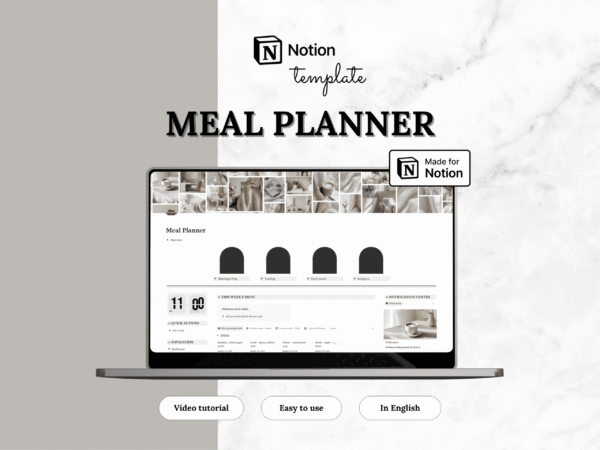
Notion template — Meal planner
Original price was: 12.00$.6.00$Current price is: 6.00$. -
Sale!
Notion template — Medical planner
Original price was: 10.00$.5.00$Current price is: 5.00$. -
Sale!
Notion template — Personal finance tracker
Original price was: 19.00$.9.50$Current price is: 9.50$.