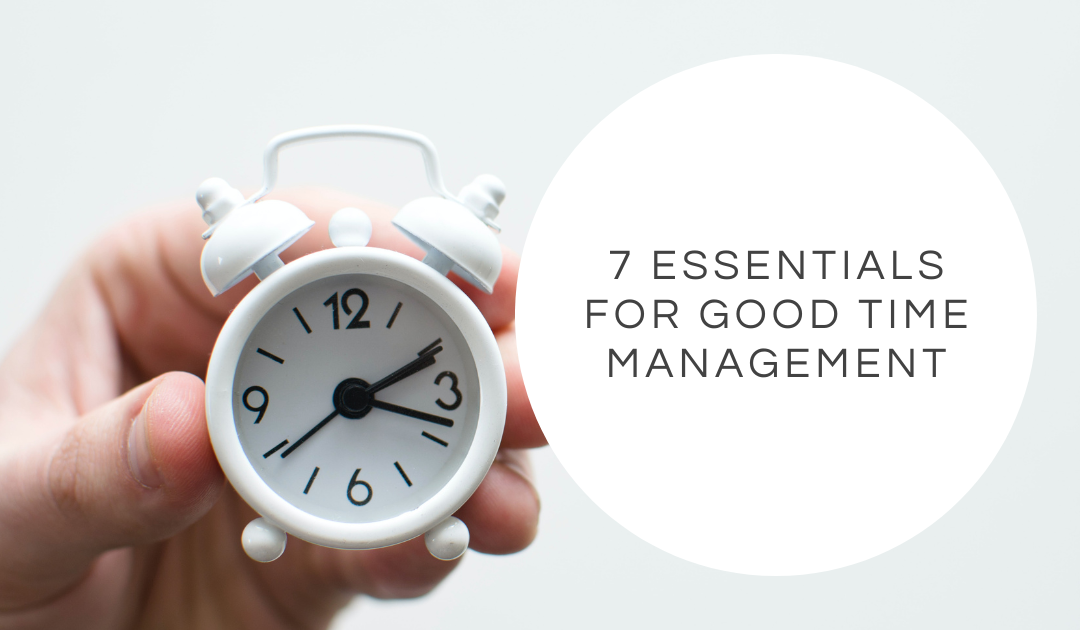
Good time management isn't just about building yourself a schedule and a to-do list. Among all the essential elements of good time management, here are 7 that I think are especially important.
1. Define the Results You Want to Achieve
Managing your time well means knowing how to achieve your results, your goals. So naturally, you have to start by clearly defining those very results.
First, you need to define your overall vision, meaning what you want to do, who you want to be, the life you want to have in a moderately near future (roughly 1 to 5 years out).
From that vision, establish the specific goals you want to reach in order to grow and get closer to that vision of your future.
And don't just keep it in your head: a study by Dr. Gail Matthews, a psychology professor at Dominican University of California, found that people who write down their goals are 42% more likely to achieve them than those who just keep them in mind.
If structuring your vision and goals on paper (or in a digital tool) isn't naturally your strength, you don't have to start from a blank page. A Notion template or a spreadsheet already designed for this can save you that most intimidating step.
2. Define Your Personal and Professional Priorities
Beyond defining your vision and goals, you need to take the time to ask yourself what's actually a priority, both personally and professionally.
The following questions can be great starting points for reflection:
- What are the most important values in your life?
- Which personal areas will always come first?
- Which people matter the most to you?
- Which commitments take up too much space without providing real value?
- What kind of clients do you want to have?
- What kind of work is most important to you?
- Which projects align the most with your values?
Good time management doesn't happen without a solid definition, evaluation, and management of your priorities.
3. Prioritize Tasks and Projects That Lead to Your Goals and Dreams
Now that your vision, your goals, and your priorities are well established, ask yourself whether the tasks and projects you do day to day actually reflect all of that.
Are you simply filling your days with pointless tasks that have no real impact? Or do these actions genuinely move you in the right direction? Where does most of your time actually go? Are reactive, unimportant tasks quietly eating up your entire day without you fully realizing it?
Make room for the actions that have a big impact on the direction you've chosen. Again, having a system already in place, whether in Notion or a spreadsheet, helps you quickly visualize where your time is actually going, rather than relying only on a vague impression.
4. Take Care of Your Physical and Mental Health
Without your health, you won't get very far. To make sure you can manage your time well long-term, you need to prioritize your physical and mental health.
Your body and your mind (you) are your most precious allies. You need to take care of them, even when you have a ton to do and you're overwhelmed. This needs to be part of your priorities, not an adjustment variable that gets sacrificed first when the schedule overflows.
It's not just about wellbeing: a Goodwill Management study found that regularly practicing physical activity increases an employee's productivity by 6 to 9%. Neglecting your health to "save time" often ends up costing you more in the medium term.
5. Give Yourself Flexibility
Good time management doesn't mean a hyper-structured, overly rigid schedule that has to be followed to the letter at all times.
We all have the unexpected pop up, no matter how much effort we put into avoiding it. Everyone has moments where things go worse than planned. Last-minute requests, emergencies, that happens to all of us. We all have moments where we're just not doing well.
There's a psychological reason that justifies this flexibility: almost all of us are naturally bad at estimating how long a task will take. A classic study conducted by researchers Roger Buehler, Dale Griffin, and Michael Ross, published in the Journal of Personality and Social Psychology, asked psychology students to estimate how long it would take them to write their thesis. The result: only 30% of them finished within the timeframe they had predicted themselves. This bias, known today as the "planning fallacy," affects nearly everyone, regardless of how experienced they are with that type of task.
Personally, I always give myself more time than I think something will take. It leaves room for the unexpected, for breaks, for inevitable distractions. It lets me avoid falling too far behind when things aren't going smoothly.
I also give myself the flexibility to move my time blocks around if that works better for me.
So it's essential that you give yourself real flexibility when planning, not because you lack discipline, but because that's what the research shows is realistic for pretty much everyone.
6. Have Fun
Don't forget this one! What's the point of all this if you're not having fun? In everything you do, always hold on to enjoyment.
Just because you have things to do, big goals, big ambitions, doesn't mean you can no longer have fun. In fact, none of it works without it.
If you want to keep going long-term, you need to prioritize things that feel good and bring you joy.
7. Do Regular Reviews and Reflect
Regularly stepping back to make sure you're staying on track and correcting mistakes faster is essential to good time management.
It's not just common-sense advice: it's measurable. A study led by researcher Giada Di Stefano of HEC Paris, along with Francesca Gino and Gary Pisano of Harvard Business School and Bradley Staats of the University of North Carolina, followed employees at a company in India. Those who spent the last 15 minutes of each training day writing and reflecting on what they had learned scored 23% better on the final test, compared to those who hadn't taken that time to reflect. In other words, stopping to reflect isn't a waste of time: it concretely improves the performance that follows.
You'll manage your time much better if you don't repeat the same mistakes for too long and if you stop to think about the impact of your actions.
I suggest doing weekly, monthly, quarterly, and annual reviews, on top of doing small end-of-day check-ins every day.
And if you're looking for a concrete starting point to put these 7 essentials into practice, my Notion templates and spreadsheets are designed exactly for that: giving you a ready-to-customize structure, instead of having to build everything yourself from scratch.
Frequently Asked Questions
Why is my schedule never respected, even when I plan well?
It's extremely common: research shows we almost always underestimate how long a task will take, regardless of our experience. Building in a margin isn't a planning failure, it's a realistic strategy.
Does taking time to reflect actually waste productive time?
No, it's the opposite. Research has shown that people who take a few minutes to reflect on what they just accomplished perform significantly better afterward.
Should I write down my goals, or is keeping them in mind enough?
Writing down your goals concretely increases your chances of achieving them, according to psychology research.
Does prioritizing my health hurt my short-term productivity?
No, quite the opposite: neglecting your physical and mental health almost always ends up costing more time and energy in the medium term than it seems to save.
Talk soon!
-
Sale!

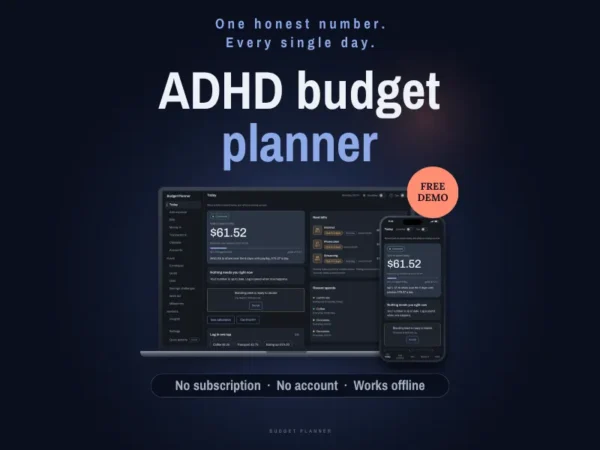
ADHD Budget Planner – App
Original price was: 30.00$.15.00$Current price is: 15.00$. -
Sale!
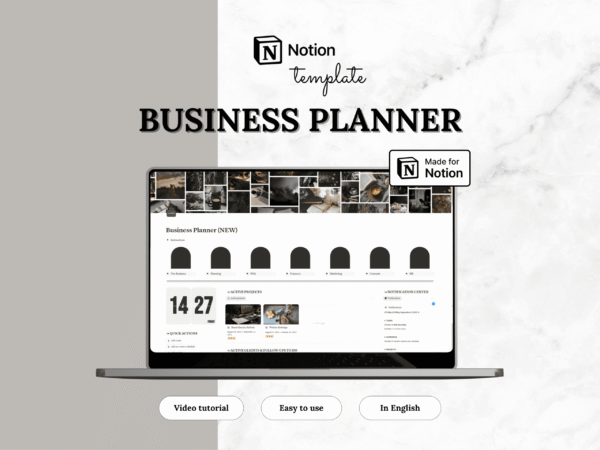
Notion template — Business planner
Original price was: 63.00$.31.50$Current price is: 31.50$. -
Sale!
Notion template — Career planner
Original price was: 16.00$.8.00$Current price is: 8.00$. -
Sale!
Notion template — Event planner
Original price was: 19.00$.9.50$Current price is: 9.50$. -
Sale!
Notion template — Fitness planner
Original price was: 19.00$.9.50$Current price is: 9.50$. -
Sale!
Notion template — GTD planner
Original price was: 20.00$.10.00$Current price is: 10.00$. -
Sale!
Notion template — Home management
Original price was: 19.00$.9.50$Current price is: 9.50$. -
Sale!
Notion template — Language learning
Original price was: 12.00$.6.00$Current price is: 6.00$. -
Sale!
Notion template — Life planner
Original price was: 47.00$.23.50$Current price is: 23.50$. -
Sale!
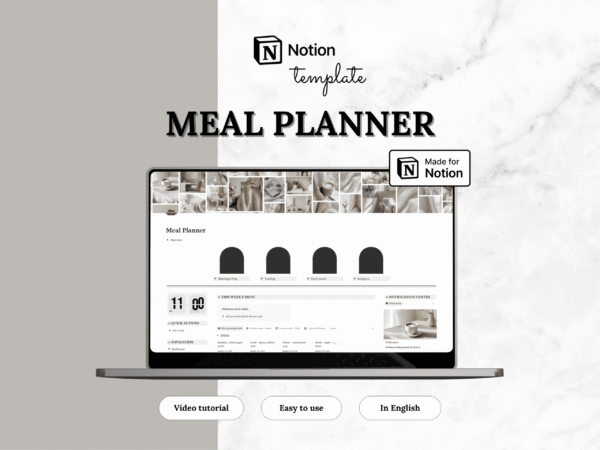
Notion template — Meal planner
Original price was: 12.00$.6.00$Current price is: 6.00$. -
Sale!
Notion template — Medical planner
Original price was: 10.00$.5.00$Current price is: 5.00$. -
Sale!
Notion template — Personal finance tracker
Original price was: 19.00$.9.50$Current price is: 9.50$.