Procrastination. You know, that thing that makes you constantly put things off until tomorrow? Your to-do list piles up, and your stress climbs right along with it.
You're really not alone in this. A large-scale meta-analysis published in the American Psychological Association's Psychological Bulletin, conducted by researcher Piers Steel and drawing on the results of 691 studies, estimates that between 15 and 20% of adults are chronic procrastinators, and that the phenomenon affects up to 80 to 95% of students at least occasionally. So this isn't some fringe personality trait: it's an extremely widespread human phenomenon.
To keep it from affecting you too negatively, you need to understand the causes of procrastination.
1. Lack of Structure and Clarity in Your Vision
You don't really know where you're headed. The days go by and you're not quite sure what you want. Why would you work on that project that's been dragging on for months when you don't even know why you're doing it or where you actually want it to lead?
It's a logical loop: without a clear destination, every task becomes an abstract chore rather than a step toward something that matters to you. Your brain needs to see the link between the effort required now and the future payoff in order to feel motivated to act. When that link is fuzzy, procrastination becomes an almost logical response: why invest energy into something whose destination isn't even clear?
In fact, that same Piers Steel research identifies setting clear, structured goals as one of the most effective interventions for reducing procrastination, far more effective than simply "forcing yourself."
You need to start by defining your big life vision, your ambitions, your dreams, and the goals tied to all of that. It doesn't need to be perfect or endlessly detailed: even a clear general direction already changes things.
If structuring your goals and projects on paper (or in a digital tool) isn't naturally your strength, having a ready-made system can make all the difference. Whether it's a Notion template to centralize your vision and projects, or a spreadsheet to concretely track your numeric goals, you don't have to start from a blank page. You'll find both formats in my shop.
2. Fear of Judgment, Failure, and the Unknown
Believe me, I get it.
You're afraid people will judge and criticize you. Afraid of not succeeding, or of making mistakes. Afraid of what you don't know, because you don't know how it's going to go. That's natural, it's human. I'm scared too. But that's part of the process.
Judgment, you can choose to ignore. Failure is learning (cliché, but true). The unknown doesn't stay unknown forever. Everything is figureoutable, as Marie Forleo would say. Start on day 1.
There's something important to know here: the way you talk to yourself when you procrastinate has a direct impact on whether you'll keep doing it. Researcher Fuschia Sirois of Durham University, who has studied procrastination for over 20 years, discovered something counterintuitive: in a study published in Personality and Individual Differences, students who forgave themselves for procrastinating on a school assignment actually procrastinated less two weeks later, compared to those who judged themselves harshly. Beating yourself up doesn't fix anything. It actually feeds the cycle, because the shame and guilt it generates make you want to avoid the task even more, just to escape that uncomfortable feeling.
In other words: self-compassion isn't a consolation prize, it's a strategy that works better than self-criticism.
3. Perfectionism
You're waiting for everything to be PER-FECT before you launch.
We don't want to look unprepared, amateurish, not expert enough or not specialized enough. That's normal too. But nothing will ever be perfect. There will never be a "right" moment. You learn by doing. You get better through action. You just have to stop overthinking it.
Here's a fact that often surprises people: that same Piers Steel meta-analysis found that perfectionism isn't actually one of the factors most strongly linked to procrastination, contrary to what a lot of personal growth books suggest. What actually predicts procrastination is how unpleasant a task feels (task aversion) and how confident we are that we can pull it off (self-efficacy). Perfectionism can feed into both of those factors, but it isn't the sole cause, or even the main one. That points to something important: if you're waiting to "cure" your perfectionism before taking action, you might end up waiting a long time for nothing. It's often more effective to work directly on making the task less aversive and building your confidence to complete it, rather than aiming to eliminate perfectionism itself.
4. You Let Yourself Get Distracted
Sources of distraction are everywhere around us. We need to learn to identify them, reduce their impact on us, and manage them.
A first exercise you could try is identifying what distracts you when you're trying to get something done, and coming up with as many solutions as possible for each one. Your phone next to you, tabs open that have nothing to do with your task, background noise, other people's requests interrupting your focus: every distraction you identify is one you can plan around ahead of time, instead of getting blindsided by it in the moment.
5. You See It as a Mountain, Without Breaking It Into Small Tasks
Sure, if you tell yourself you need to write a 1,000-page book, ugh, that's heavy. What's the first action you can take today toward that? That's what you should be thinking about: small actions and the first step. Then the second step, and so on. A mountain that's too big will naturally make you want to back away.
Your brain reacts to a huge, vague task almost like a threat: it looks to avoid it rather than tackle it. A task broken down into concrete, achievable steps doesn't trigger that same resistance. "Write a book" is intimidating. "Write the outline for chapter one for 20 minutes today" isn't.
6. You're Low on Energy
You need to generate your own energy, put every chance on your side. How? With good nutrition, good sleep, physical activity, plenty of water, and so on. Add that to your planning, put it on your schedule, and make a deal with yourself. (Or with someone else, mutual support never hurt anyone!)
It's not just a question of discipline: a tired body and brain objectively have fewer resources to tackle a demanding task, which makes procrastination even more tempting. Taking care of your energy isn't a distraction from your goals: it's one of the conditions for reaching them.
7. Lack of Motivation for the Projects You're Working On
Is this really the right thing to be doing? Is this actually what you want? Sometimes you need to step back, pause, and ask yourself the right questions. It's also possible you're just not in the right place. You have to accept that and take the time it takes to get to know yourself.
Not all procrastination is solved the same way. Putting off a task because it's poorly broken down isn't the same thing as putting off a project because, deep down, it no longer feels like you. The second case calls for reflection, not just more discipline.
I've procrastinated on a lot of things too (it still happens to me today, actually, you don't magically become perfect overnight. In fact, you never become perfect.) I TO-TAL-LY get it.
Try to identify your own reasons. Anything can be fixed, and the first step is often just becoming aware of what's going on. And if lack of structure is part of your reasons, my Notion templates and Google Sheets & Excel spreadsheets are there to give you that starting point.
Frequently Asked Questions
Is procrastination a rare personality trait?
No, quite the opposite. It's estimated to chronically affect 15 to 20% of adults, and to affect the vast majority of students at least occasionally.
Is perfectionism really the main cause of procrastination?
Not according to research. What best predicts procrastination is how unpleasant a task feels and how confident we are in completing it, not perfectionism itself.
Should I be harder on myself to stop procrastinating?
No. Research shows the opposite: forgiving yourself for procrastinating reduces future procrastination, while self-criticism tends to reinforce it.
Why does breaking a task into small steps help so much?
Because a huge, vague task triggers a natural form of avoidance, while a small, concrete, achievable first step doesn't trigger that same resistance.
Talk soon!
-
Sale!

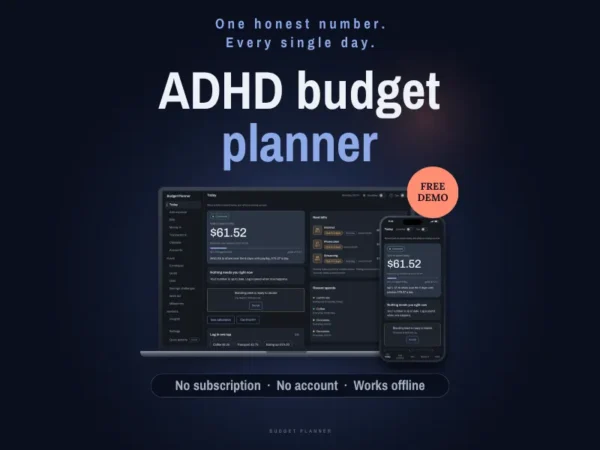
ADHD Budget Planner – App
Original price was: 30.00$.15.00$Current price is: 15.00$. -
Sale!
Notion template — Business planner
Original price was: 63.00$.31.50$Current price is: 31.50$. -
Sale!
Notion template — Career planner
Original price was: 16.00$.8.00$Current price is: 8.00$. -
Sale!
Notion template — Event planner
Original price was: 19.00$.9.50$Current price is: 9.50$. -
Sale!
Notion template — Fitness planner
Original price was: 19.00$.9.50$Current price is: 9.50$. -
Sale!
Notion template — GTD planner
Original price was: 20.00$.10.00$Current price is: 10.00$. -
Sale!
Notion template — Home management
Original price was: 19.00$.9.50$Current price is: 9.50$. -
Sale!
Notion template — Language learning
Original price was: 12.00$.6.00$Current price is: 6.00$. -
Sale!
Notion template — Life planner
Original price was: 47.00$.23.50$Current price is: 23.50$. -
Sale!
Notion template — Meal planner
Original price was: 12.00$.6.00$Current price is: 6.00$. -
Sale!
Notion template — Medical planner
Original price was: 10.00$.5.00$Current price is: 5.00$. -
Sale!
Notion template — Personal finance tracker
Original price was: 19.00$.9.50$Current price is: 9.50$.